



Your work counts.
Lanyard is an operating platform for festivals and a reputation network for the people who run them. I designed it. I built it. Then I ran a real festival on it.
getlanyard.app
The problem
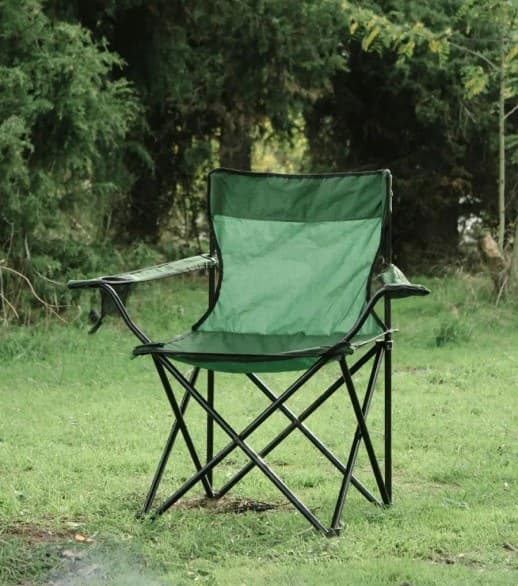

50% no-show rate
Slipshod, 2025 — tracked in spreadsheets, and by standing in a field with work to do and nobody arriving to do it.
Deposits are a tax on
missing infrastructure.
Festival volunteering runs on distrust
Festivals staff their gates, bars and welfare tents with volunteers. To stop them flaking, festivals charge deposits — £130 held against your promise to show up. The amount is the festival's to set; that was ours.
It doesn't work, and it isn't fair.
- Deposits punish poverty, not behaviour. £130 filters out people who can't float it, not people who won't turn up.
- Good volunteers start from zero every year. The person who stayed through the storm has nothing to show for it next season.
- Reputation exists — it just can't travel. Crew chiefs remember who was brilliant. That knowledge dies when the festival ends.
Grassroots festivals at this scale rarely break even — ours didn't. When the margin is already negative, every no-show is a hole you patch with money and people you don't have. The tools for running crews properly just didn't exist at a price this end of the industry could touch.
Where it comes from
Organiser, crew, artist, punter — I was all four before I designed for any of them.
I started out running a soundsystem. Then designing and building stage arenas at other people's festivals. Then production — six years of it. By 2019 I was camping in head production at Boomtown.
I never volunteered through the normal process. Not once. I got in on relationships — people who'd seen me work and vouched for me. That's a nice thing to be able to say and a terrible way to run an industry. Everyone without that network hands over £130 to prove they'll turn up.
The hardest part of running my own festival wasn't the licensing or the build. It was keeping track of people — who showed up, who didn't, who'd paid a deposit, who needed feeding, who was owed what. And the bit that got me wasn't the admin. It was watching people work that hard, with real skills, and having nothing to give them back.
All of that was real, and none of it was written down anywhere. It lived in my memory and in a few crew chiefs' heads, and it died when the weekend ended. So I built somewhere for it to go.
The insight

Reputation beats deposits
A volunteer with three festivals and a 95% completion rate doesn't need to hand over £130 to prove they'll show up. Their history proves it.
So the design brief wrote itself: capture the history, make it portable, make it worth something. A volunteer's deposit at their first festival: £130. After one good festival: £80. After three: nothing. Trust, priced in.
| Tier | Track record | Deposit |
|---|---|---|
| New | No history | £130 |
| Returning | 1 festival, 80%+ completion | £80 |
| Proven | 2 festivals, 90%+ completion | £50 |
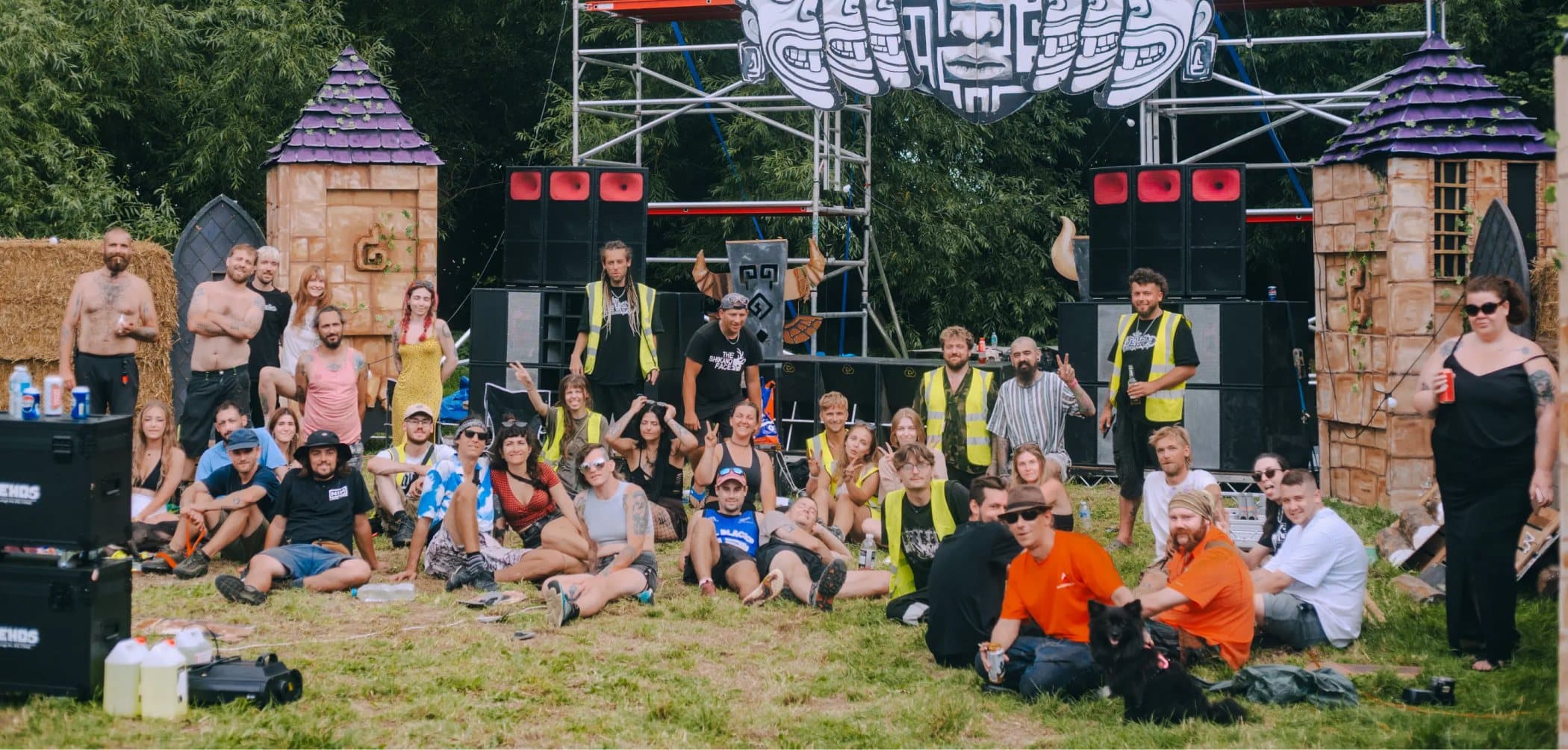
Your work counts. Wear it on your chest.
It's not just a scheduler. It's a way of noticing and showing other events what this person did for us.
For events it's a clever bit of SaaS. For workers it makes them feel seen.
The design challenge
Five audiences. One data network. Zero tolerance for confusion.
Lanyard isn't one app. It's one platform wearing six faces:
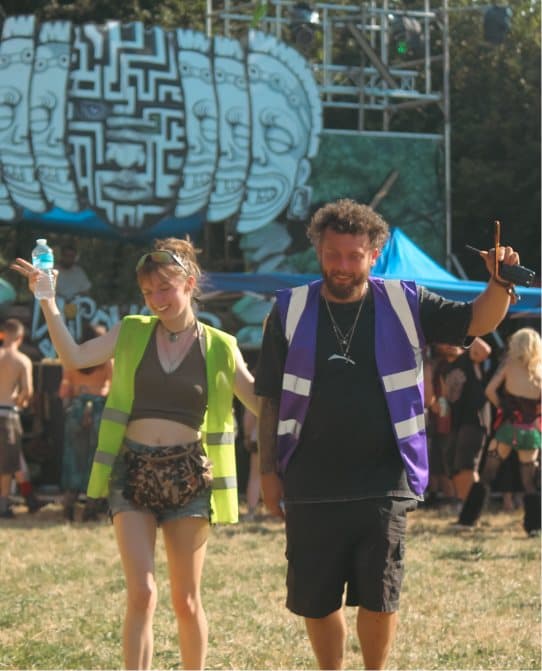
Organisers
An admin CMS that runs the whole event — crew, shifts, lineup, passes, maps, deposits
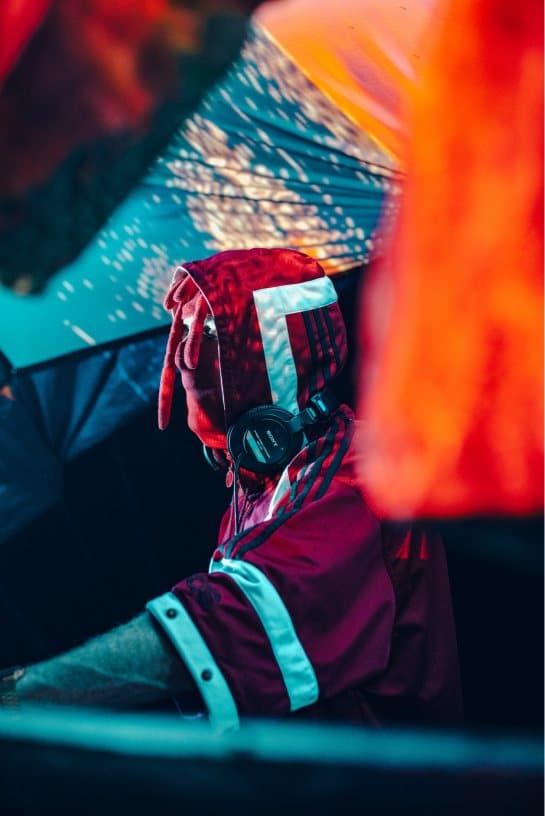
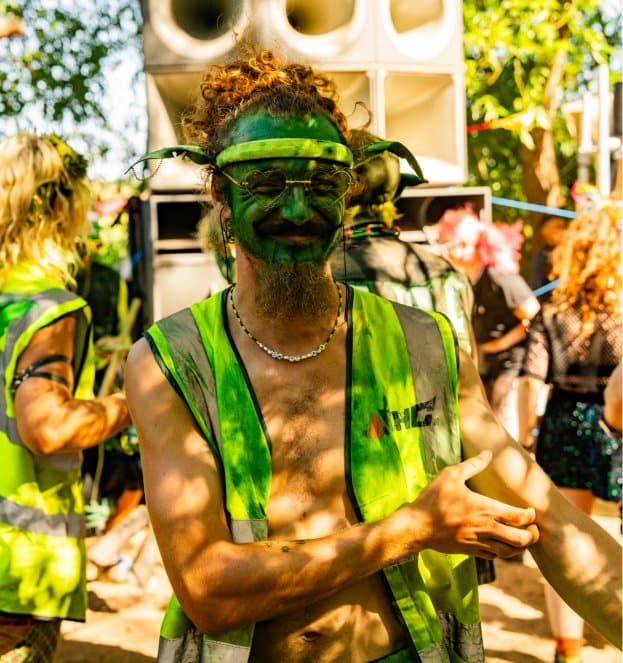
Artists & Performers
A verified network profile, gig history, passes, festival-branded share cards
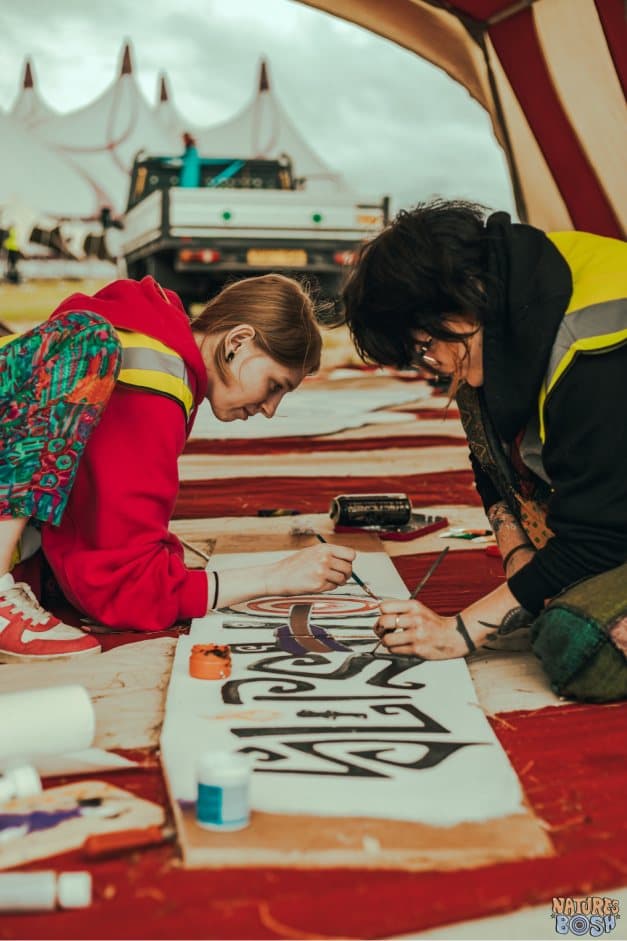
Volunteers & crew
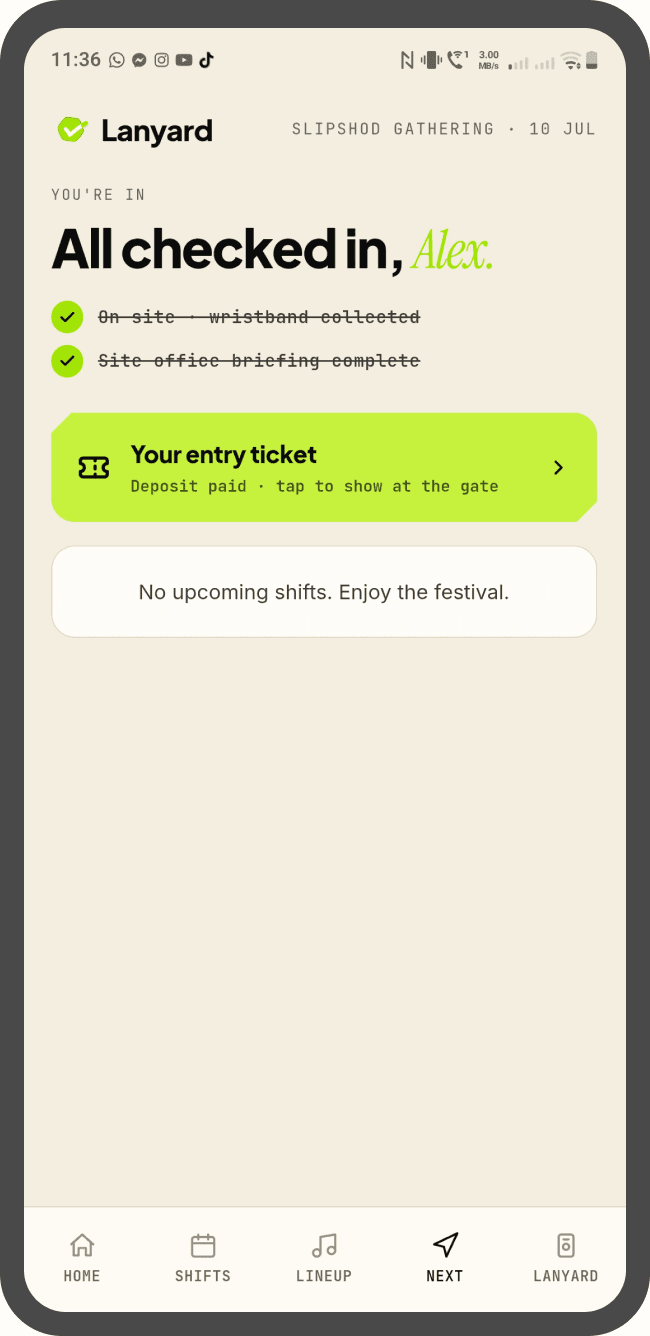
Shifts, wayfinding, check-in, an entry ticket, and a reputation that follows them
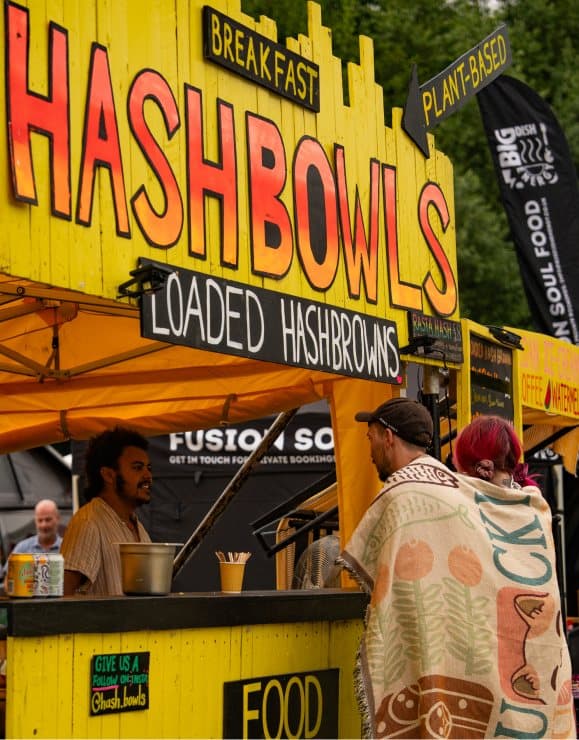
Vendors & stalls
Self-service profiles, entry passes, a map listing
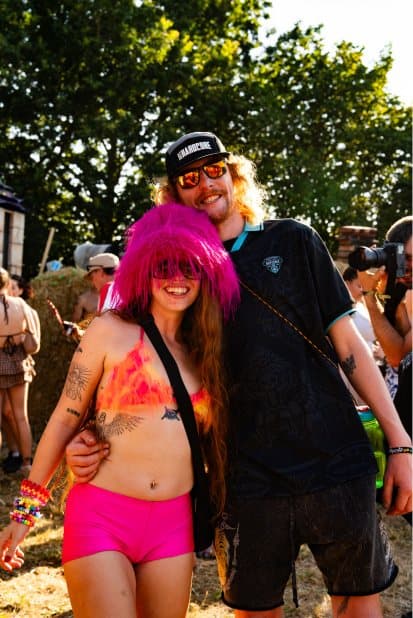
Punters
A festival-branded web app on the festival's own domain — timetable, picks, site map
The Brand
I wanted a brand that makes someone feel seen.
The name covers events: a lanyard is your pass behind the scenes. Proof you're supposed to be here.
The language is shaped for the workers, not the buyers. The colours come straight off a hi-vis. The type is marker pen — because that's how events actually run: scribbles, tape, a rota on the crew mess wall. It needed to belong in that environment, not turn up looking like a shiny SaaS product.
Why hexagons?
It's a hive. Worker bees, all doing their bit for something bigger — the event. Each cell is a shift that actually happened. There's no score and no leaderboard because I didn't want one. It's not a game, it's a record.
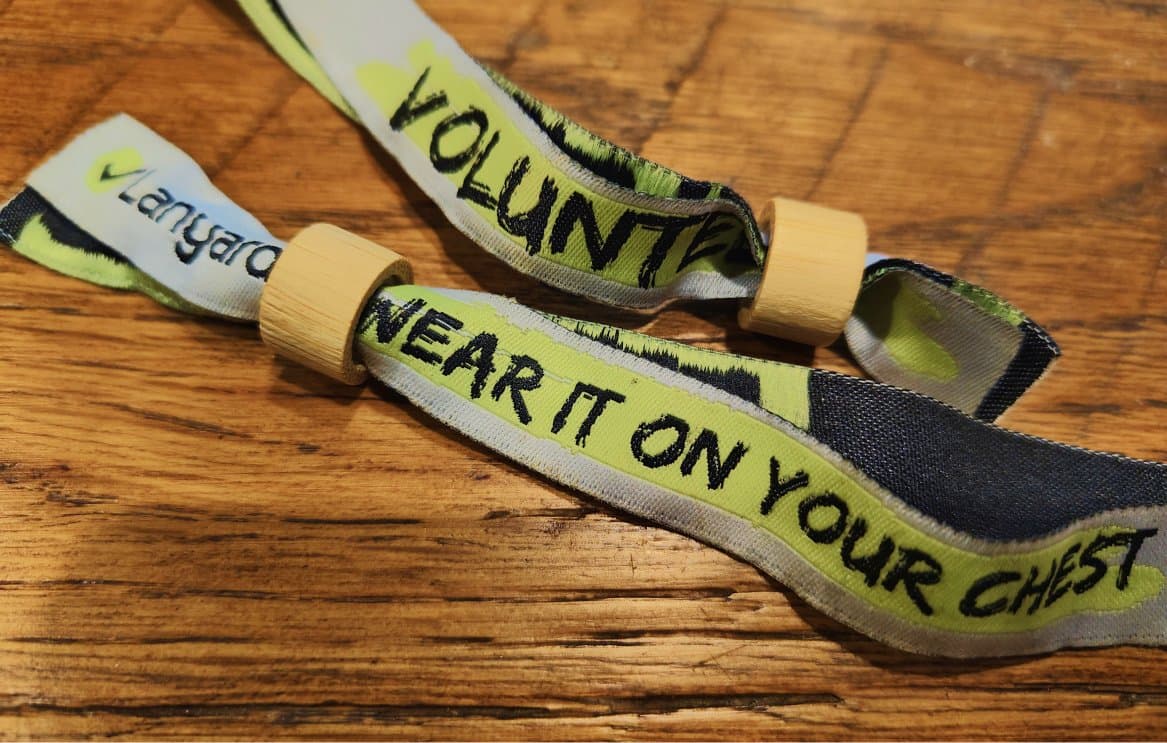
Woven. Worn all weekend.
Deep dive The worker app
Designed for a field, not a desk
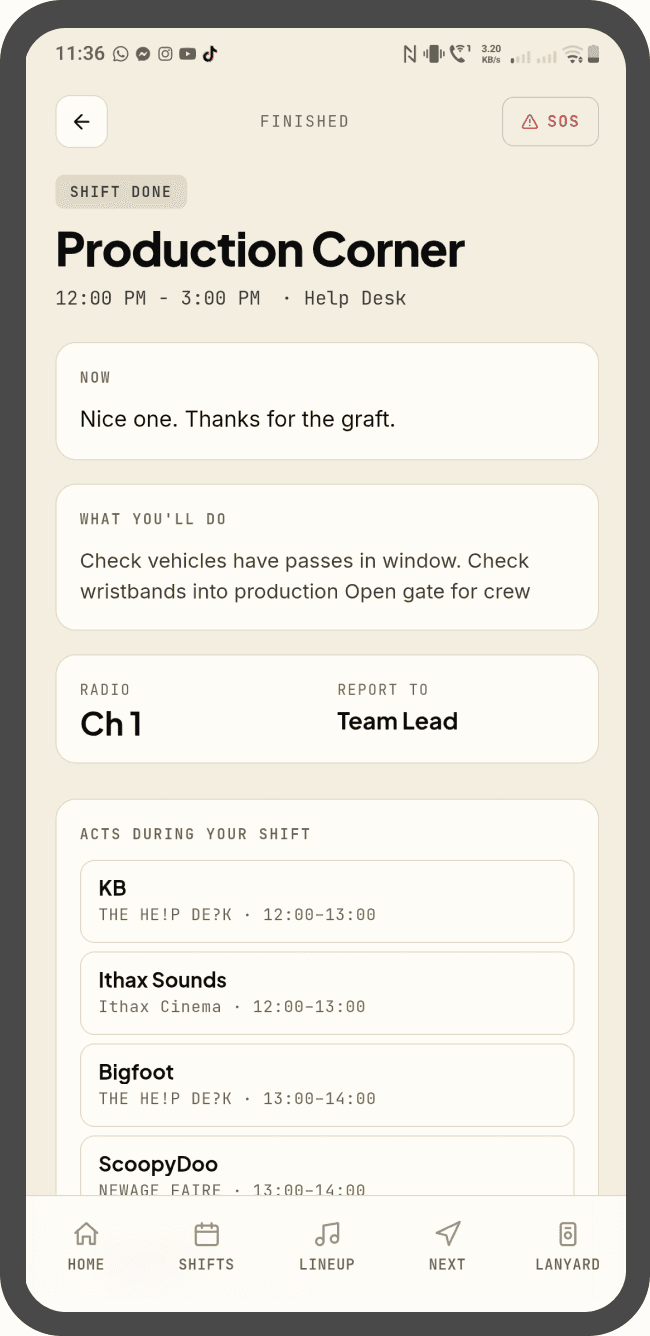
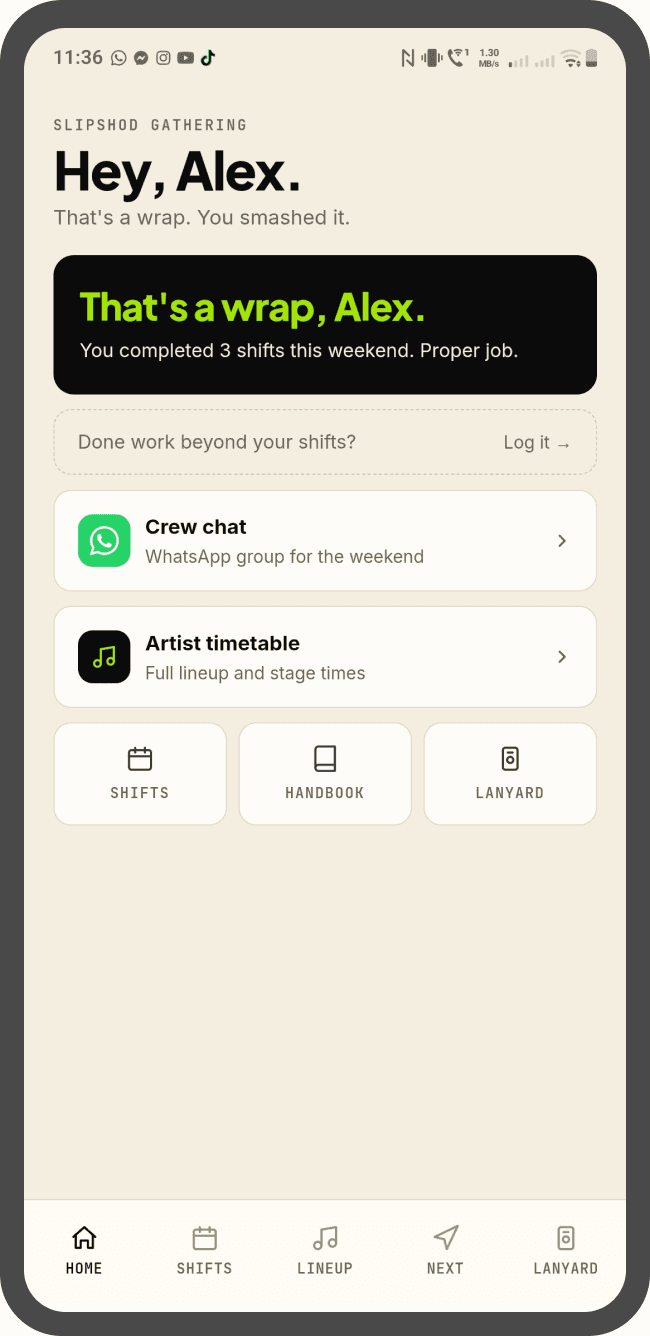
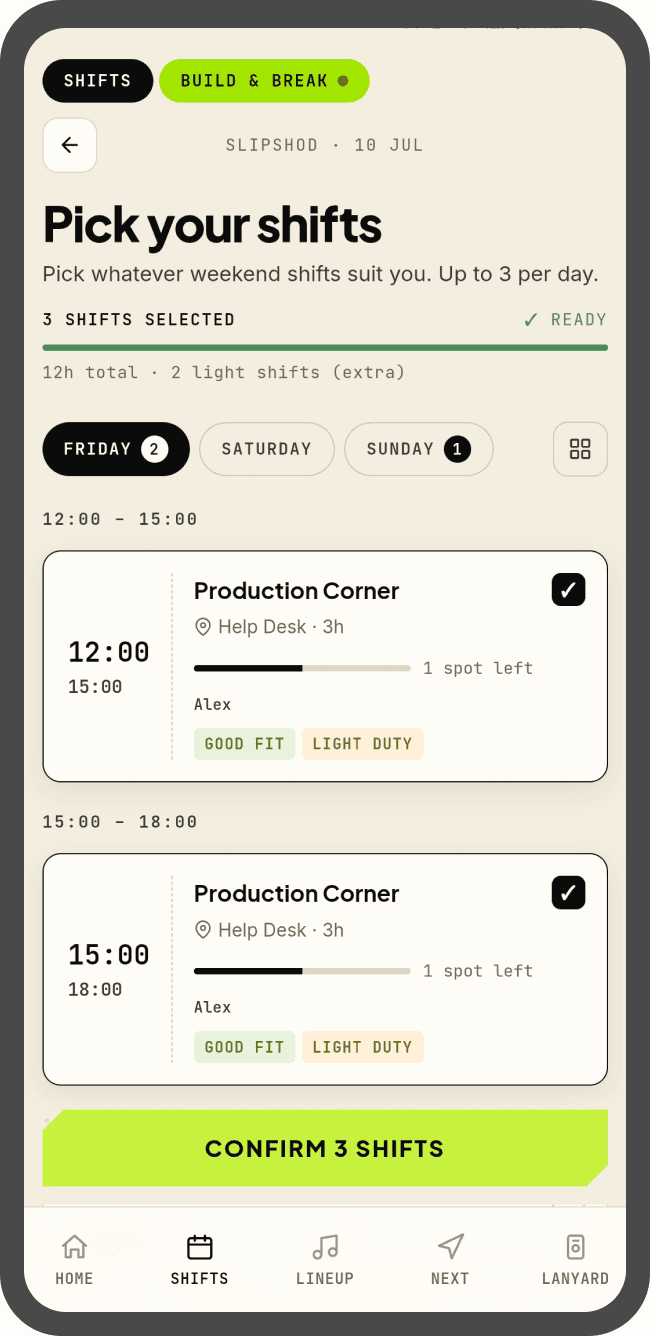
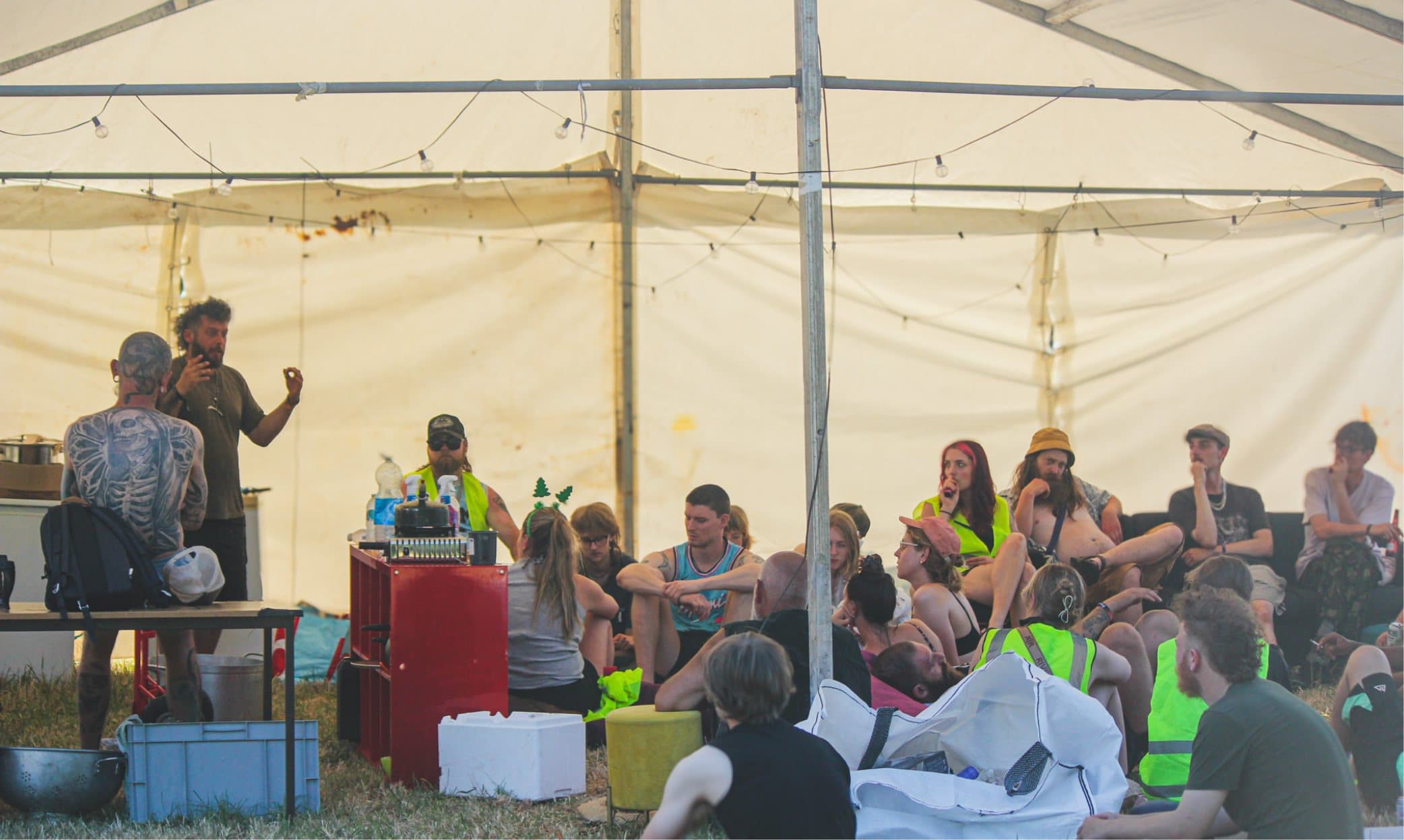
Volunteers use this on a cracked phone, in the rain, half-way through a ten-hour build day. Every interaction is shaped by that.
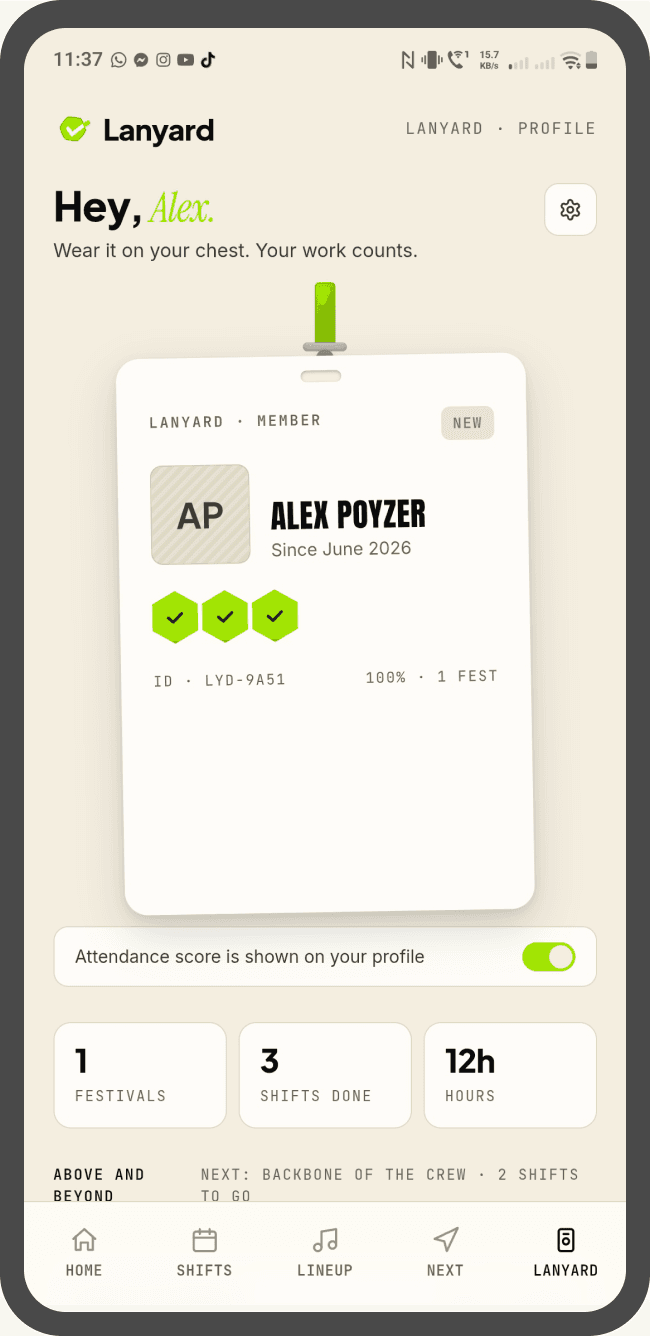
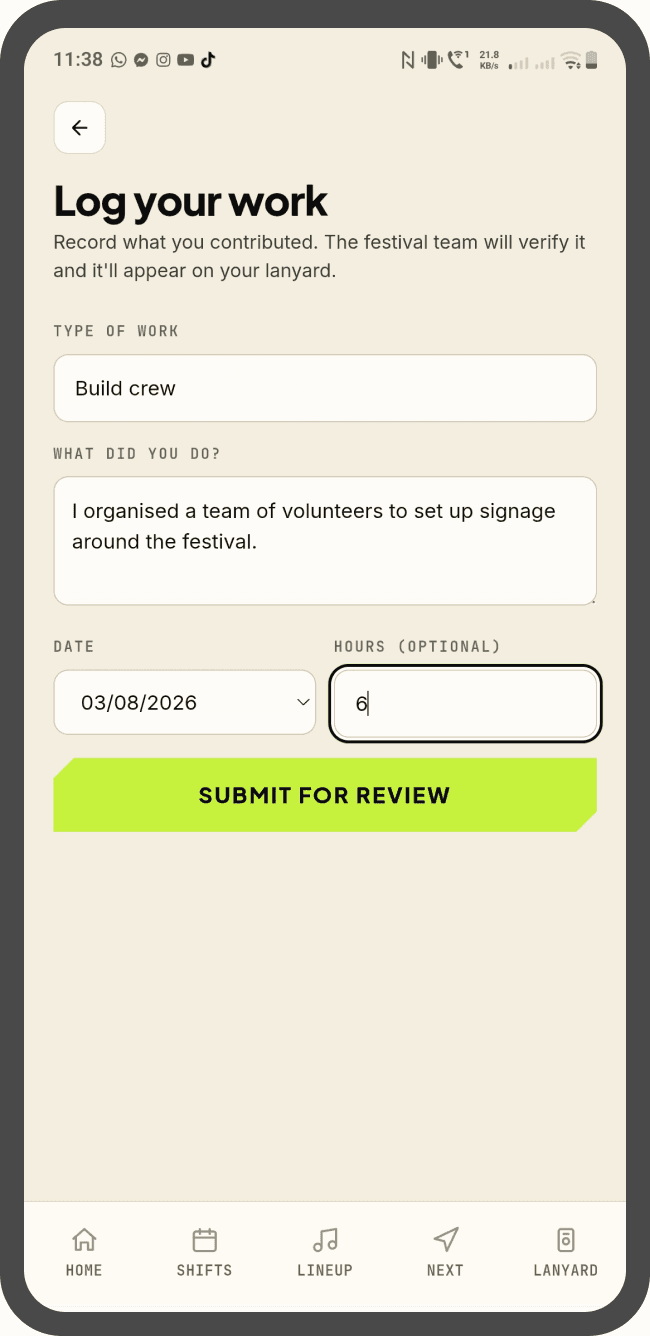

Building your lanyard
It fills as you work. Every completed shift adds a cell. Hours, roles, endorsements, recorded by the event as it happens. Nothing on it is self-reported.
The Journey

Signup
You arrive through a festival: a signup link from an event that runs on Lanyard.
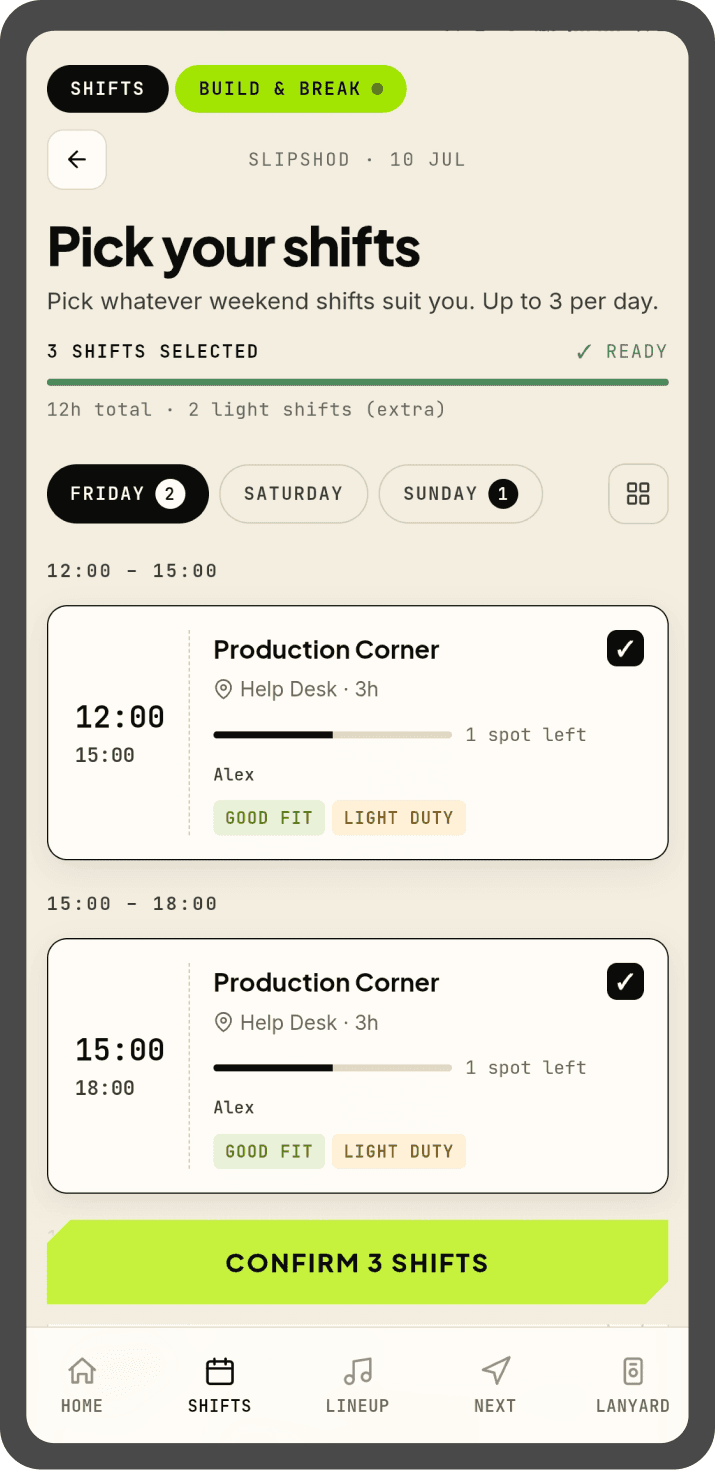
Pick your shifts
Matched to you, capped at three a day. Some roles are earned before they're offered.
Build your lanyard
It fills as you work — shifts, hours, endorsements. A CV you earn, not write.
Live event mode
On the day, the app knows where you are in the weekend: one job, one CTA, one next thing. Safety always on screen.
Post event
Endorsed, recorded, kept. Your work doesn't end with the weekend — it's on your lanyard when the next festival asks.
Find work
Use your record to apply for other festivals and events. Grow your career.
Real data captured
Crew signups
Shifts completed
Completion rate
Deep diveAdmin CMS
This is where lanyard began
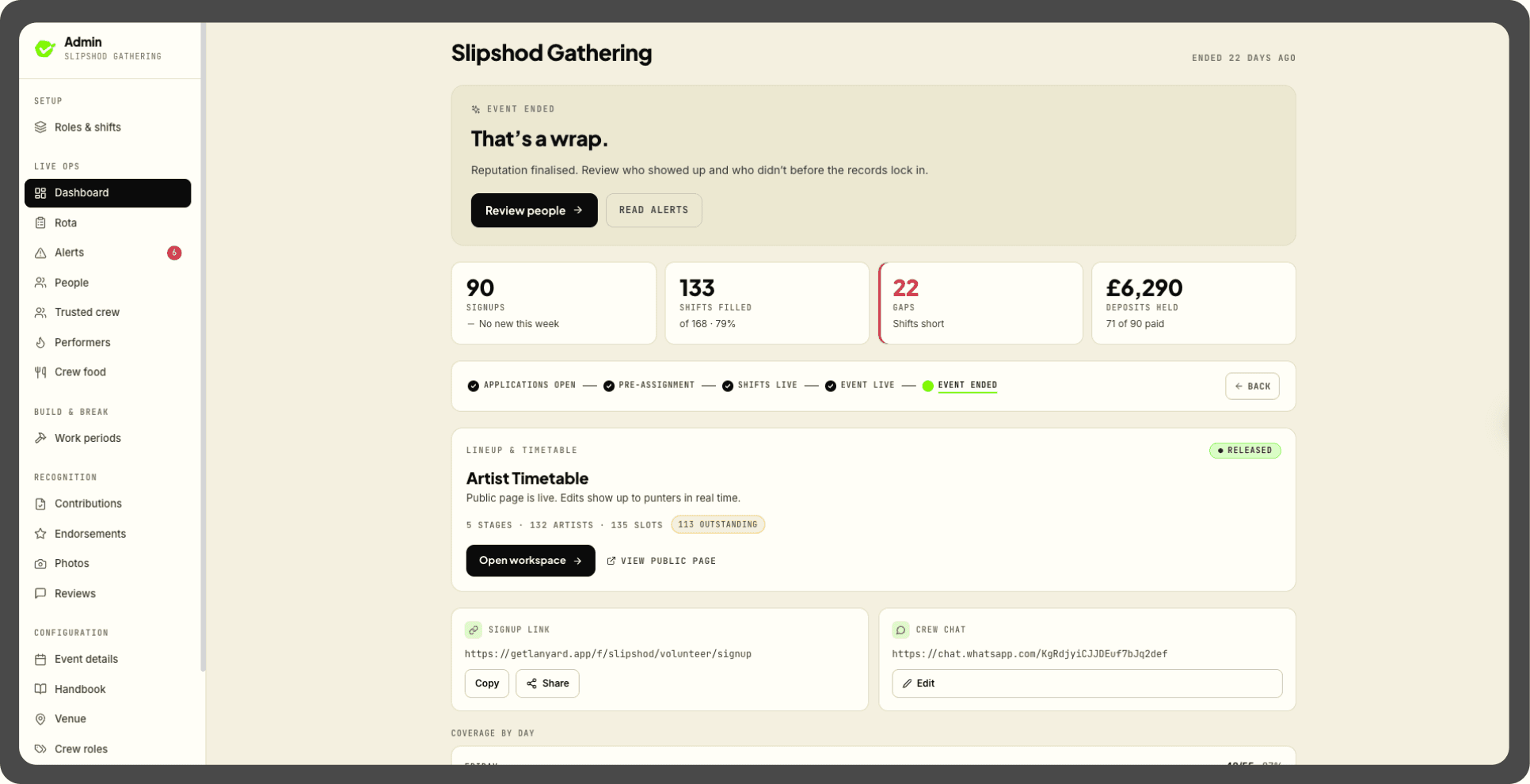
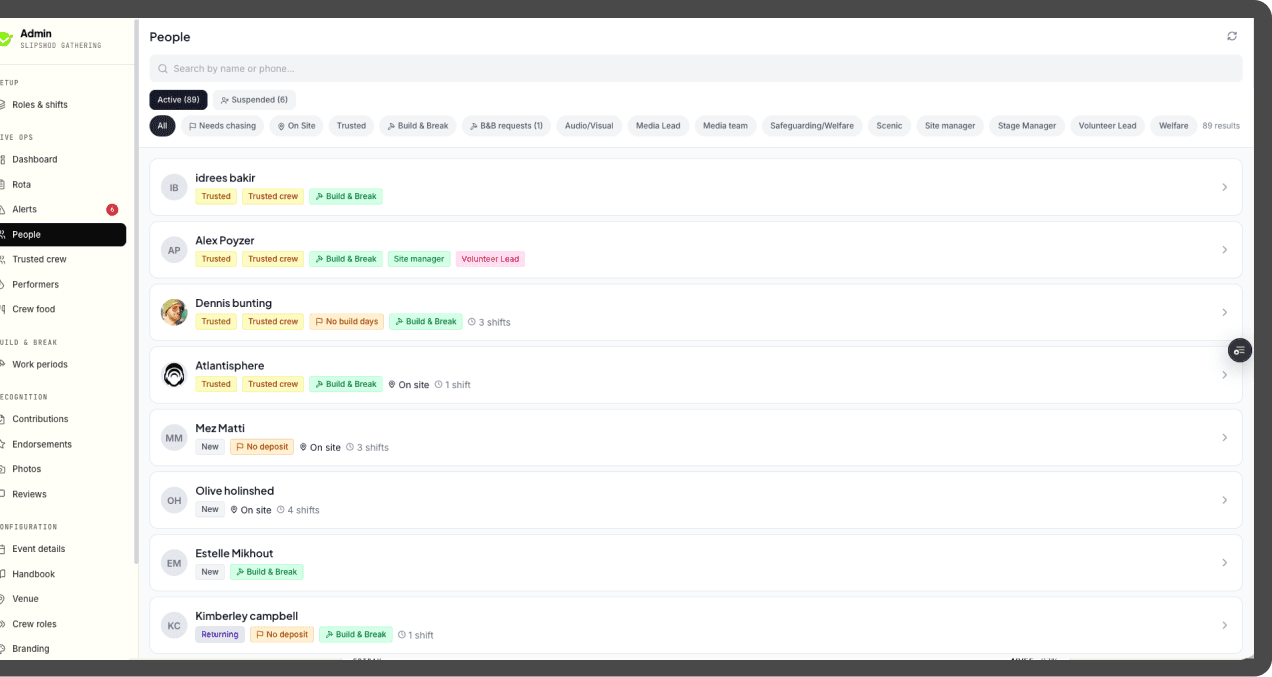
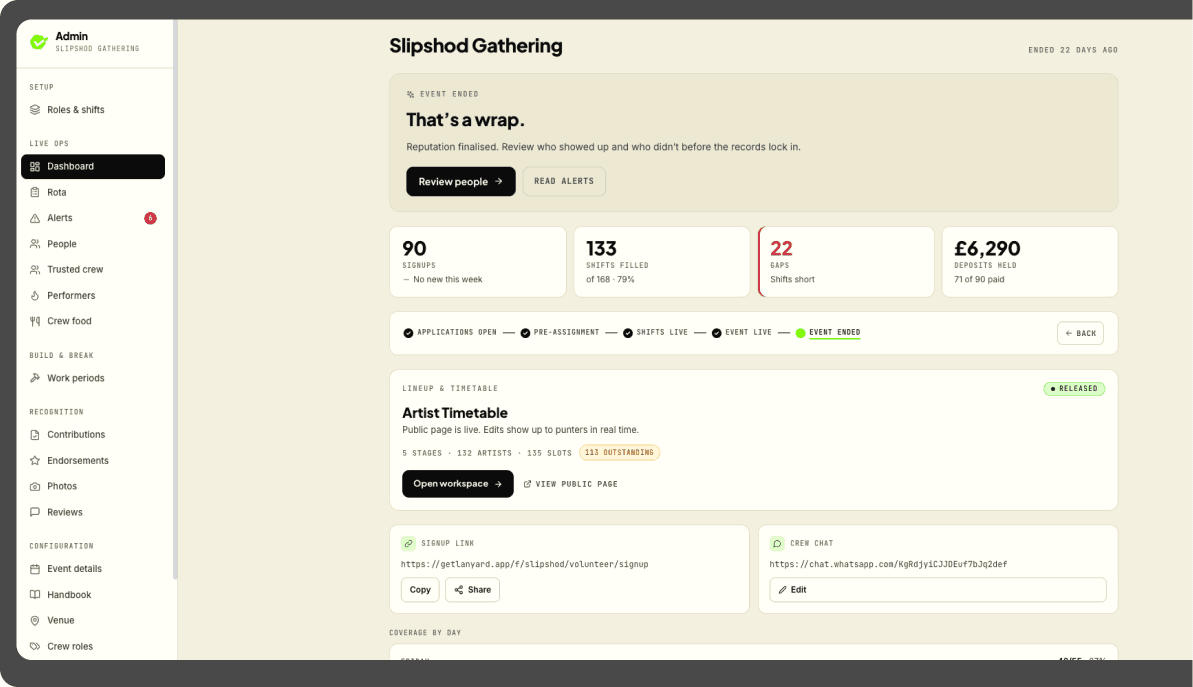
Lanyard started as the tool I needed. I ran a music festival without it for a year, so every feature in the admin exists because a real weekend demanded it. And what I needed turned out to be what every organiser needs — so I made it multi-tenant.
Designed and built for real needs
Shifts build themselves. Tell it “gate cover, 8am–8pm, four-hour shifts” and it generates the lot. No spreadsheet.
The rota is dynamic — shifts added, swapped or removed on the fly, from a laptop or a phone in a field.
A life cycle state machine — Applications open → Pre-assignment → Shifts live → Event live → Event ended — so the whole team always knows what phase the event is in, and reputation finalises automatically when it ends.
Recognition tools — endorse crew against five named qualities, tag photos, verify beyond-shift contributions. The admin gives recognition; the worker decides what to display.
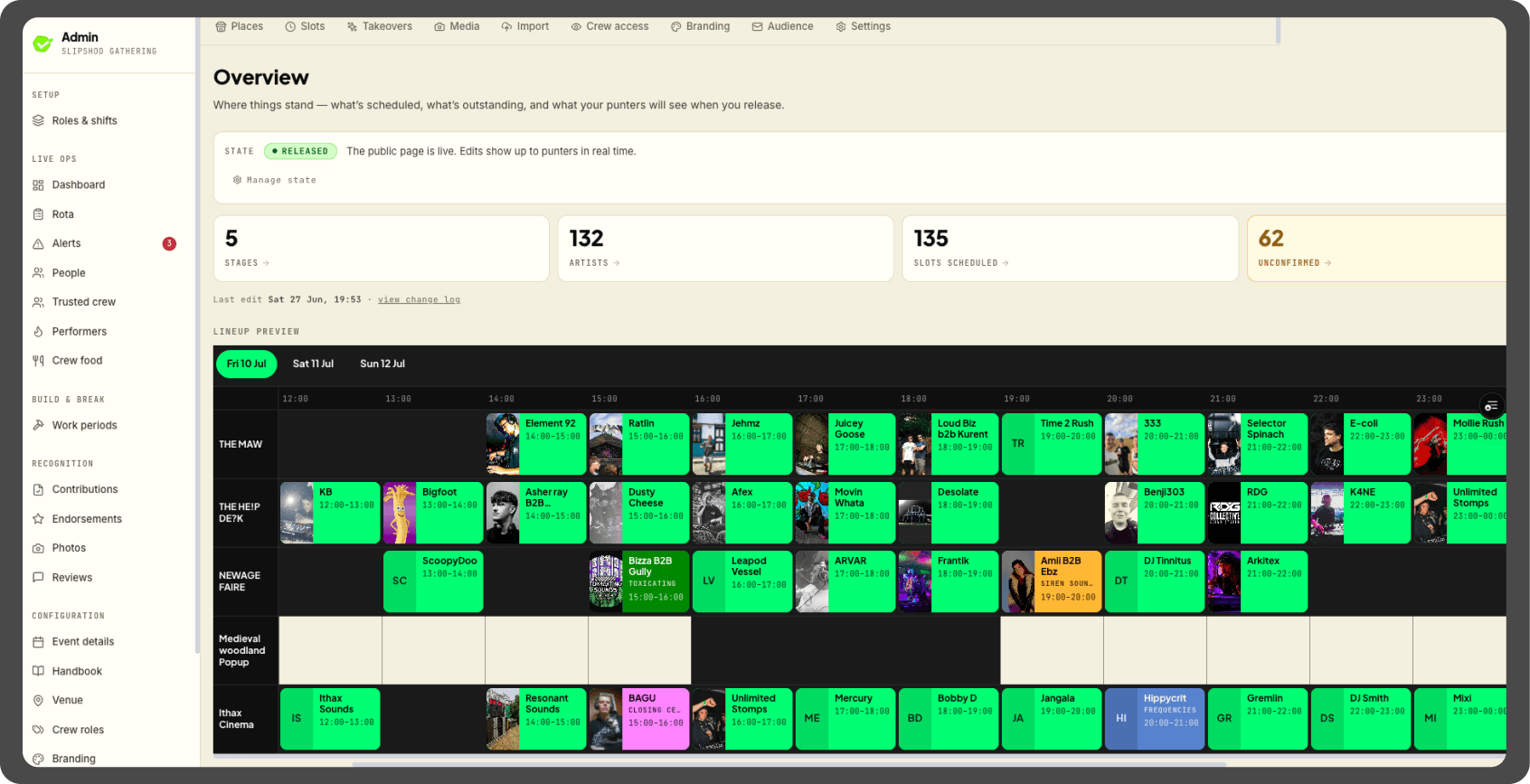
Deep dive132 artists, one link
The best admin interface is the one you never open
A Self serve artist platform
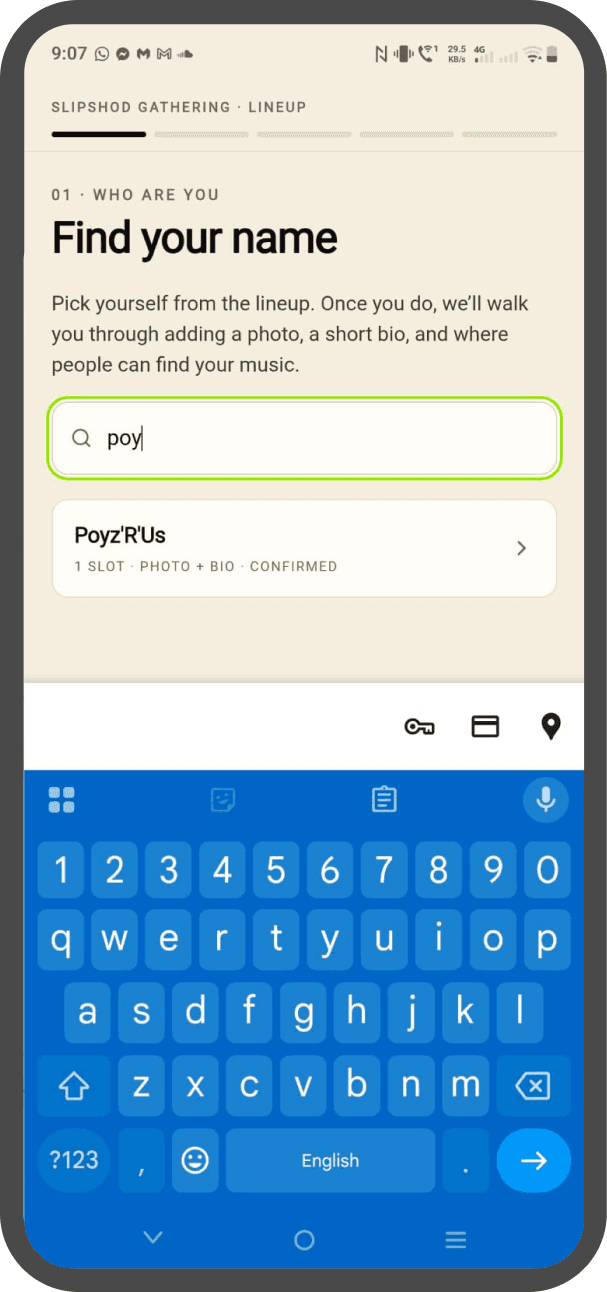
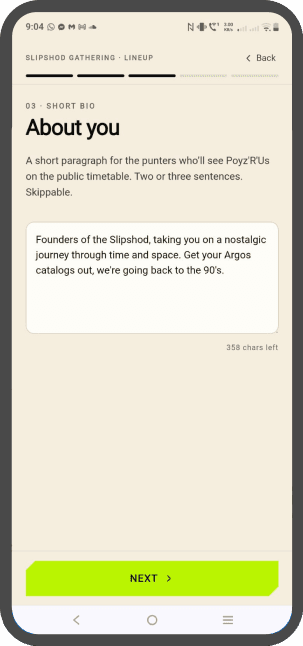
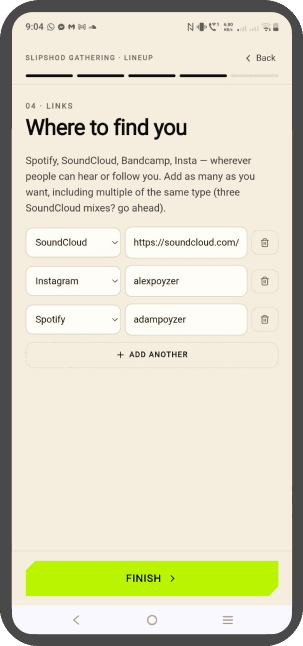
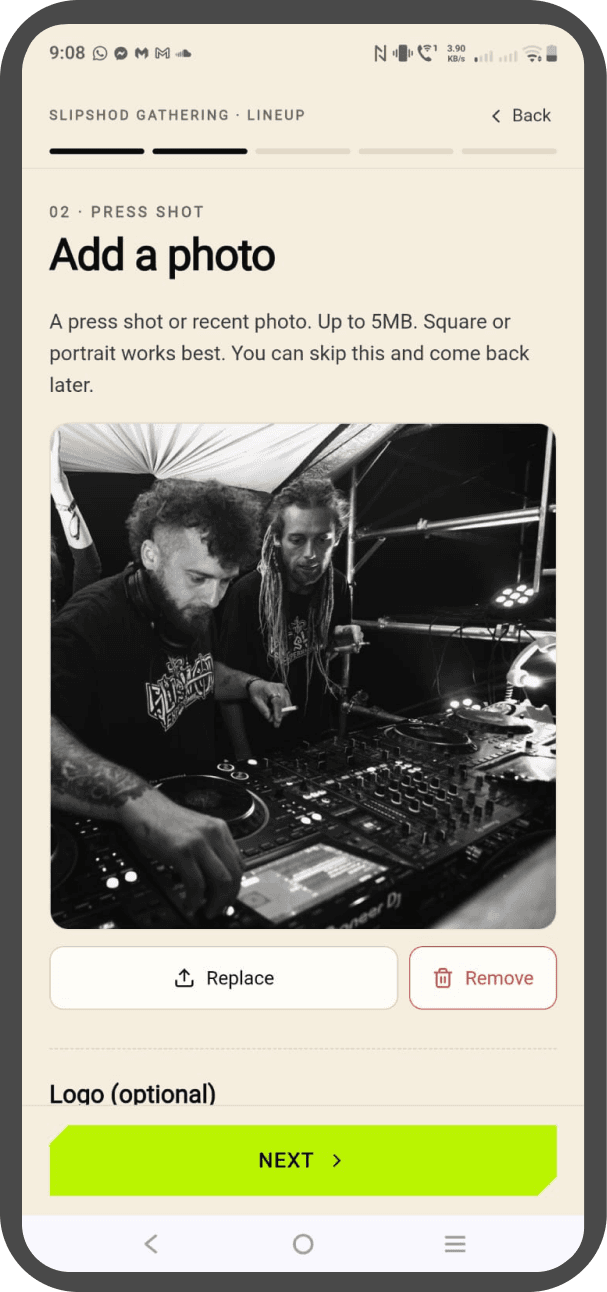
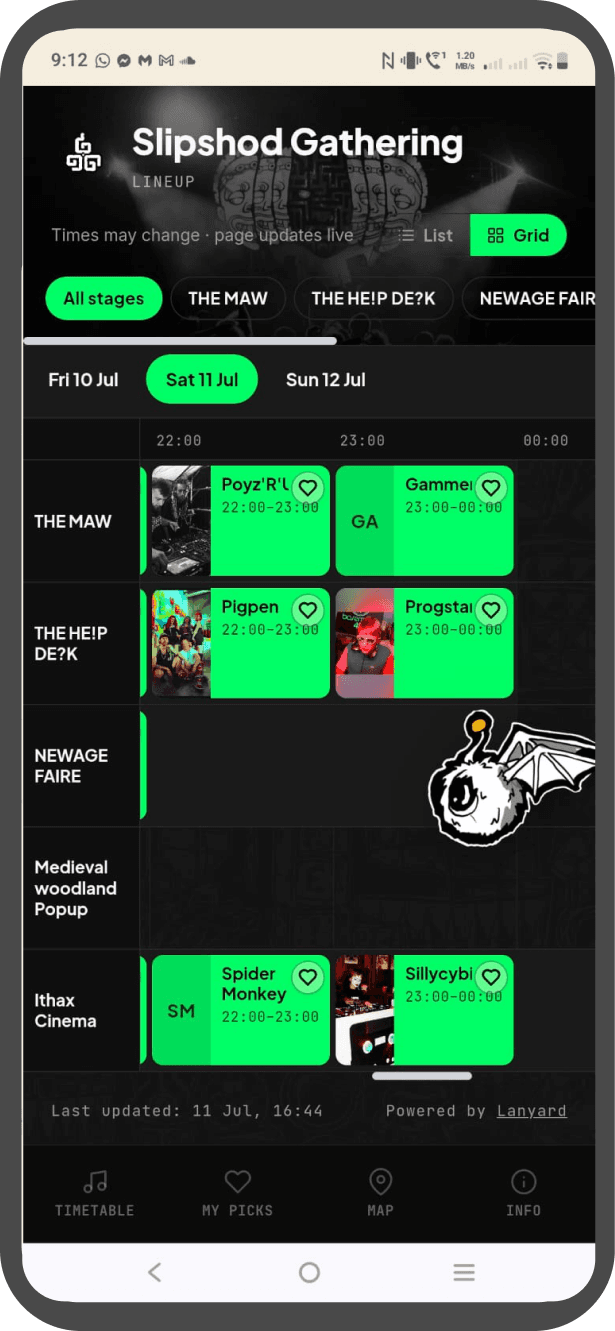
I wanted an interactive timetable — nothing unique there. What I didn't want was to chase 100+ artists for photos, bios and social links.
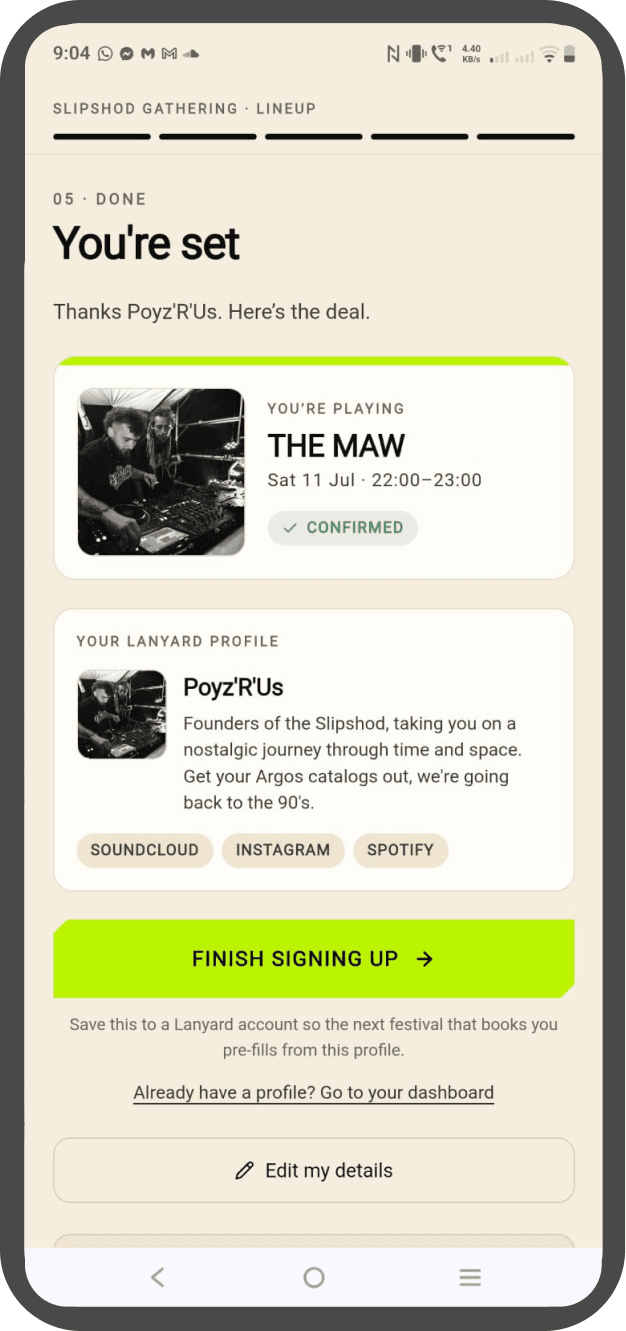
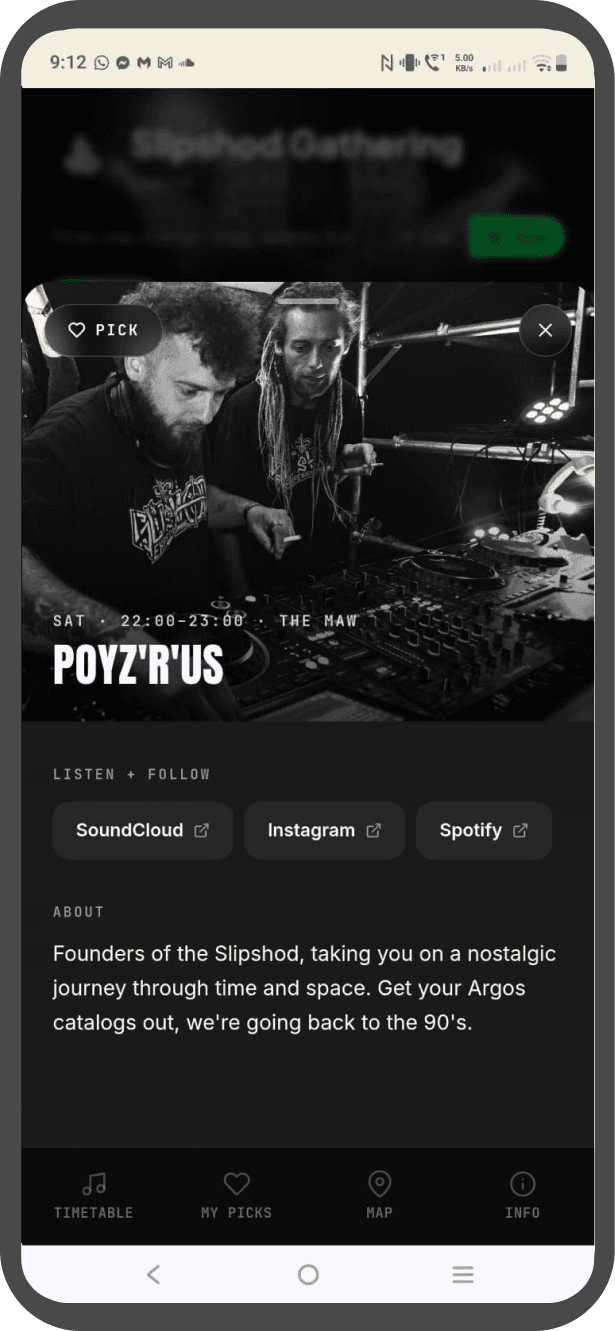
Every artist got one link. They filled in their own information — photo, bio, socials — written by them, not the organiser, not AI. It went straight onto the punter-facing app.
And every artist with a photo got a festival-branded share card, generated from a CMS template, to post their own set time.
Real data captured
Artists across 5 stages
Added their own photo
Punter emails, consented
Deep dive The punter app
The festival's app, not Lanyard's
Punters never saw Lanyard. They got a festival-branded web app on the festival's own domain — timetable, artist pages, site map, favourites. No download, no account, no app store: a link that works on the phone you arrive with.
Hundreds of people planned their weekend on it: 2,381 timetable picks — about five per person on site — across 132 artists and five stages.
And 56 punters handed over their email on purpose — every address captured came with marketing consent. It's a small number and a clean one, and any organiser knows which of those is worth more.
What I said no to
The product is also the features it doesn't have
- No points, badges, streaks or leaderboards.
Recognition, not gamification — the hive and named milestones are the ceiling. - No numeric ratings of workers. Ever.
Endorsements are qualitative and consent-gated. Negative data stays local; positive data travels. - No in-app chat.
Crews already live in WhatsApp. Lanyard links out instead of competing. - No social feed, no likes, no comments.
This is a work credential, not a network to perform on. - No festival re-theming of worker surfaces.
Even though I built full theming for punter surfaces — different audiences, different rules. - No punter ticketing.
Lanyard does accreditation — who's allowed in, and why — not ticket sales. Festivals already have ticketing partners; the crew side was the unserved half. I drew that line early and held it.
The pilot & the result
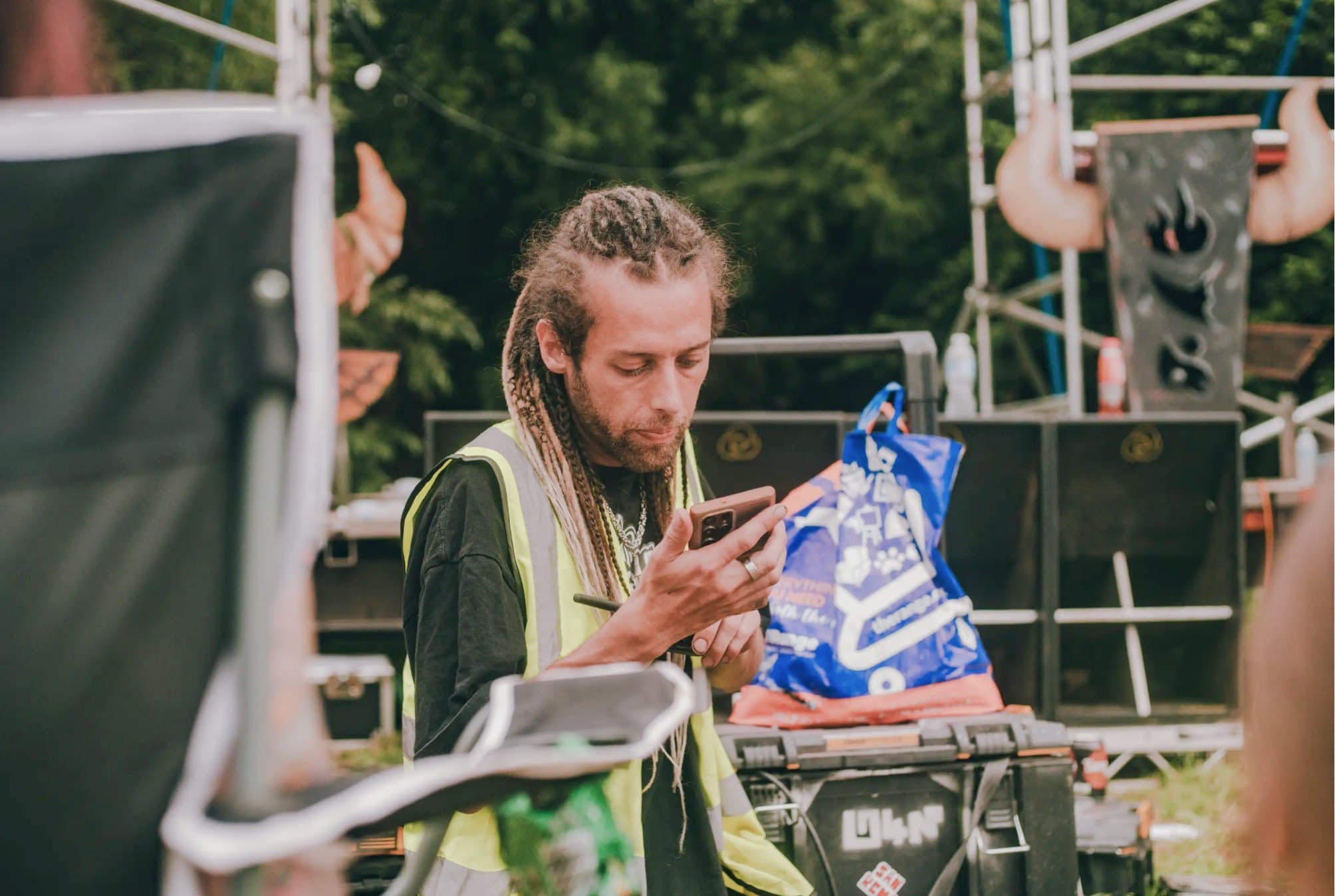
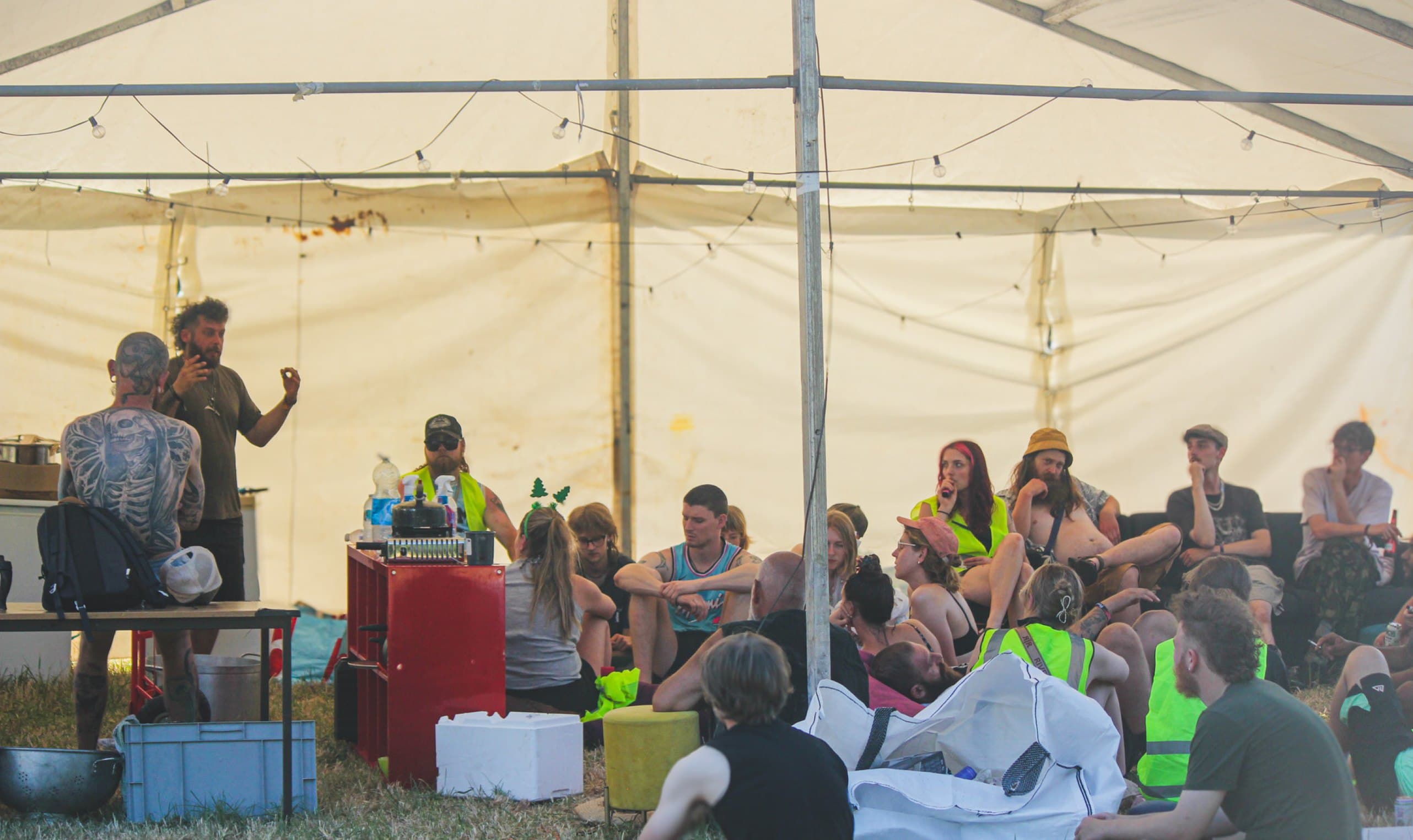
Three days in a field, for real
Slipshod Gathering, Scholey Park, Lincolnshire — 10–12 July 2026. Every number below was recorded by the product itself. Final figures, pulled from the live system August 2026.
Crew
Timetable & audience
2025 no-show
2026 no-show
50%
14.3%
What I learned
The journey I designed ended with the festival. The workers didn't.
I didn't put enough thought into post-event. Endorsing crew was mostly manual, and the UX for how a worker submits their work was never clear. Deposits were tracked in Lanyard but not processed — sending them back was a manual job, and once sent, there was no way to mark them returned.
Lanyard's whole promise is that the work counts afterwards. Afterwards is exactly where I under-built. If I did it again, I'd design the ending first — the moment the worker gets what they earned — and work backwards into the weekend.
The point, in one person
Ella came to Slipshod's first year to paint decor. By the end of the weekend she'd picked up a walkie-talkie. By the second year she'd quit her job to organise it with me — volunteers, circus performers, vendors — and led the volunteer team on Lanyard. This summer she was at Y Not Festival, paid, shadowing a stage manager.
She got that work the old way: people who'd seen her graft talked. That's how reputation moves in this industry — by voice — and it only reaches as far as the people who happened to be there. Lanyard exists to write it down.
I built a product to help me run a festival. That's not where the journey ends.